
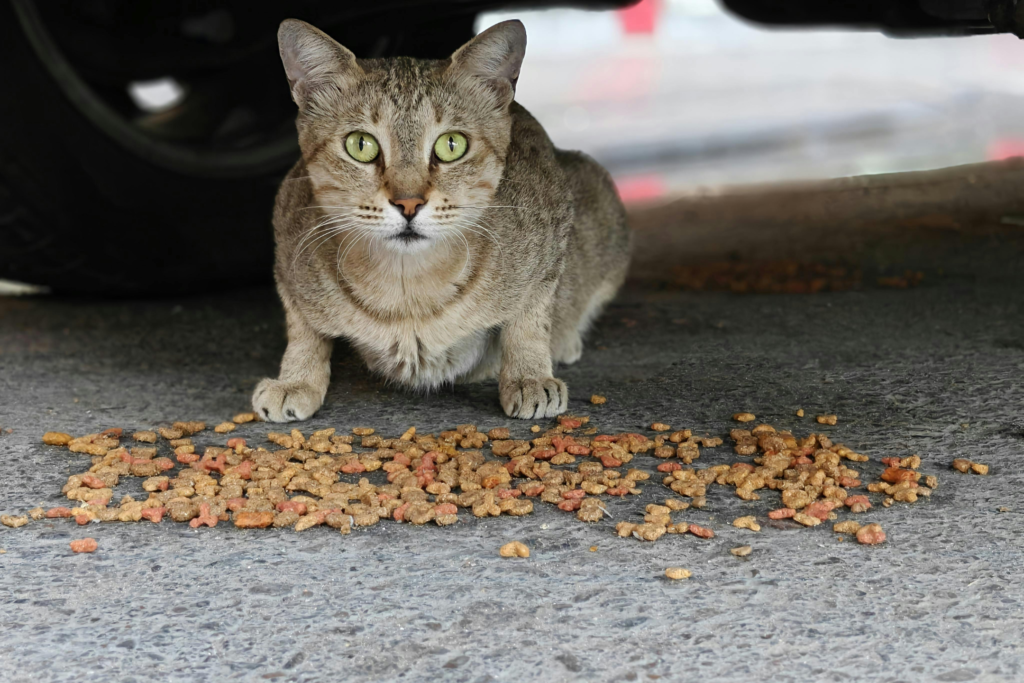
If you have ever filled your cat’s bowl with kibble and called it a day, think of it as the feline version of living on instant noodles or packaged biscuits. Both are convenient, shelf-stable, and easy to fall back on daily, which makes dry food the default choice for most Indian households. But convenient for us does not always mean best for them, just like a person could survive on instant noodles for years without dropping dead, yet would likely deal with fatigue, weight gain, or kidney strain from the excess carbs and low protein over time. Here is what vets and research actually say about feeding cats a dry food only diet, especially in Indian conditions where heat and humidity make hydration even more important.
Cats Are Built for a Very Different Diet
Cats are obligate carnivores. Their bodies evolved to survive almost entirely on meat and on the moisture packed inside it. In the wild, a cat’s natural diet of rodents and birds is roughly 70% to 80% water, with only about 3% to 5% of calories coming from carbohydrates.
Dry kibble flips that ratio completely. It is typically only 6% to 12% water, and most dry cat foods contain 35% to 50% carbohydrates just to hold their crunchy shape. That mismatch between what cats evolved to eat and what a bag of kibble provides is the real reason dry food only diets raise health concerns, much like a diet of instant noodles is heavy on refined carbs and light on real protein and moisture.
Why This Matters Even More in India
India’s climate makes hydration a bigger daily challenge for cats than it is in cooler countries. Long, hot summers across most of the country and high humidity in coastal cities mean cats lose more moisture through panting and normal activity. A cat already prone to low water intake has even less margin for error when temperatures climb past 35 to 40 degrees Celsius for months at a time. Vets in India increasingly point out that a dry food only diet, combined with our summers, is a common contributor to urinary and kidney issues seen in clinics across the country.
The Main Health Risks of Feeding Only Dry Food
- Chronic low-level dehydration Cats have a naturally low thirst drive, a trait believed to come from their desert-dwelling ancestors who got most of their water from prey rather than by drinking. The Cornell Feline Health Center notes that cats eating mostly dry food usually need to drink more water to compensate, and recommends that cats consume roughly 4 ounces of water per five pounds of body weight every day. Most cats fall short of this consistently, and over time that adds up to chronic mild dehydration.
- Urinary tract problems This is the most well-documented risk of a dry food only diet. Concentrated, low-volume urine gives minerals more opportunity to form crystals and does not flush the bladder as effectively. Dr. Richard Goldstein, a veterinarian formerly at Cornell University’s College of Veterinary Medicine, has said that at least half of a cat’s diet should ideally be wet food, since the added moisture helps flush the urinary tract and supports urinary health. Urinary blockages are also a genuine emergency, and Indian vets frequently see them worsen in male cats during peak summer months when water intake drops further.
- Obesity Dry food is calorie-dense and is often left out for free grazing, which makes overeating easy. Weight gain is a growing concern among Indian pet cats too, particularly indoor cats with limited exercise space in apartments.
- Long-term kidney strain Kidneys rely on adequate fluid intake to filter waste efficiently. Chronic dehydration is believed to place extra long-term strain on kidney function, a concern that grows more serious for senior cats or cats already showing early signs of kidney disease, which is unfortunately common in older cats.
It is worth being clear that not every claim about dry food holds up equally well. Some concerns, like dry food being uniquely responsible for dental disease or diabetes, are more debated among vets than the hydration and urinary link, which has the strongest evidence behind it. According to a veterinary blog by Walkerville Vet in Australia, there are really only two food-type-specific risks backed by solid evidence: lower urinary tract disease is more common on dry diets, while dental disease is somewhat more common on wet diets, though good quality dry dental formulas can help offset that.
When to see a vet immediately: if your cat strains in the litter box, cries while urinating, produces little to no urine, or the belly feels tender to touch, treat this as an emergency. Urinary blockages, especially in male cats, can become life-threatening within a day. Do not wait it out at home.
Is Occasional Dry Food Okay?
Yes, absolutely. Occasional dry food, whether as a topper, a treat, or a meal now and then, is completely fine for most healthy cats. The problem is not dry food itself. It is relying on it as the daily, primary diet without making up for the hydration and protein gap. A cat whose main meals are wet or fresh food, with kibble showing up now and then rather than every day, can do very well. The real trouble tends to show up when dry food is the only or main thing a cat eats, day after day, especially when it is left out for free feeding.
How to Choose a Good Quality Dry Food
Since kibble is likely to stay in the rotation in some form, it is worth knowing how to pick a better one when you do buy it. Start with the ingredient list, which by law is arranged by weight, heaviest first. Look for a named animal protein such as chicken, fish, or lamb in the first two or three ingredients, rather than vague terms like “meat” or “animal derivatives.” Named meat meals, such as chicken meal, are actually a good sign despite sounding processed, since they are concentrated protein with the moisture already removed, which is why they often rank higher on the list than fresh meat.
Next, check the guaranteed analysis panel, which is a legal requirement on every pack and lists minimum or maximum percentages for crude protein, crude fat, crude fibre, and moisture. For an adult cat, aim for a minimum crude protein of at least 30% to 40%, since the bare legal minimum of around 26% is a survival floor, not a healthy target. Crude fat is ideally in the 15% to 20% range, and crude fibre should sit somewhere around 2% to 5%, since too much fibre dilutes the actual nutrition your cat is getting. Moisture in dry food will usually be capped around 10% to 12%, which is exactly the low-hydration issue this article has been talking about.
One thing to watch for: these percentages include the food’s moisture, so they cannot be compared directly between wet and dry food. Dry food naturally shows higher protein numbers on the label simply because it has so much less water in it to begin with. Because of this, only use the guaranteed analysis to compare one dry food against another dry food, not to compare a dry food against a wet food.
Beyond the numbers, an adequacy statement confirming the food is complete and balanced for your cat’s specific life stage (kitten, adult, or senior) is a baseline requirement, but it should not be the only thing you check, since it only confirms a formula meets a minimum standard rather than that it is genuinely high quality. Treat it as a first filter, then look at the protein and fat numbers above and the quality of the named ingredients to judge the food properly. If you are ever unsure how to interpret a specific label, your vet can help you compare options side by side.
Practical Solutions for Indian Pet Parents
The goal is not to find a clever workaround for dry food. It is to make wet or fresh food the backbone of your cat’s diet, with dry food as an occasional addition rather than the daily default.
- Make wet or fresh food the main meal, not a side dish. A number of vets and veterinary nutritionists now recommend building the diet around canned, pouch, or gently cooked fresh food, since it is typically at least 70% to 75% water compared to dry food’s 10% to 12%, and tends to be higher in animal-based protein and lower in carbohydrates. A commonly cited approach is to keep wet or fresh food as roughly 70% of meals, with kibble making up a smaller portion rather than the reverse. Brands widely available in India, such as Whiskas, Me-O, Royal Canin, and Drools, all offer wet or gravy options alongside their dry ranges, so switching does not mean hunting for niche imports.
- Treat kibble as a topper or occasional meal, not the daily staple. Small amounts of dry food are fine now and then, whether as a training treat, a puzzle feeder filler, or an occasional meal when you are travelling. What is best avoided is kibble being the only thing your cat eats, day after day, for years.
- If you want to try fresh, home-style food, do it properly. A homemade or lightly cooked fresh diet can be excellent for cats, but it needs to be nutritionally balanced with the right vitamins, minerals, and taurine, since cats cannot make enough taurine on their own and a deficiency can lead to serious heart and eye problems. Do not put together a fresh diet without guidance from your vet or a veterinary nutritionist first.
- Make fresh water more appealing regardless of what you feed. Place multiple bowls away from food and litter, try a pet water fountain since moving water attracts many cats, and change the water at least once a day, especially in summer when it warms up quickly. [LINK TO HYDRATION ARTICLE WHEN UPLOADING: for a full breakdown of ways to get your cat drinking more, see our guide on how to hydrate your cat.]
- Watch portions, not just food type. Free feeding dry food is one of the biggest drivers of feline obesity, so scheduled meals or a portion-controlled feeder help regardless of what you are feeding.
- Choose a nutritionally complete formula. Whichever food you pick, check the label for a statement confirming it is complete and balanced, not just a treat-style product, and look for named animal protein like chicken or fish near the top of the ingredient list.
- Watch the litter box closely. Fewer visits to the litter box, straining, or very concentrated urine are early warning signs worth a call to your vet, and they tend to show up faster during hot months.
- Talk to your vet about your specific cat. Age, weight, kidney health, and any history of urinary issues all affect the right balance of wet, fresh, and dry food, so a quick check-in with your vet is worth it before making major changes.
General rule of thumb: if you notice reduced appetite, lethargy, vomiting, diarrhoea, or any change in urination or bowel habits that lasts more than a day, it is best to consult your vet rather than wait for it to resolve on its own.
Frequently Asked Questions
Can cats survive on dry food only in India’s climate? They can survive, but it is not the healthiest long-term choice. India’s heat increases fluid loss, so cats on a dry food only diet need to work even harder to stay adequately hydrated, which raises the risk of urinary and kidney issues over time.
How much wet food should I add to my cat’s diet? There is no single fixed number, but many vets suggest wet food make up close to half the diet where possible. Even one wet meal a day makes a noticeable difference to hydration.
Is dry food good for my cat’s teeth? Dry food offers some dental benefit through chewing, but the effect is modest for regular kibble. Specially formulated dental kibble tends to work better than the idea that any dry food cleans teeth on its own.
What are signs my cat is not drinking enough water? Watch for reduced urination, very dark or strong smelling urine, low energy, dry gums, or skin that stays tented when gently pinched. If you notice these signs, consult your vet rather than waiting it out.
The Bottom Line
Dry food is not the enemy. It is a matter of balance. The strongest evidence points to one clear takeaway: cats need more moisture and protein than dry kibble alone reliably provides, and that gap is closely tied to urinary tract and hydration-related health issues, a risk that is only heightened by Indian summers. A diet that includes wet food, encourages good water intake, and keeps portions in check gives your cat the best of both worlds: the convenience of kibble without the downsides of relying on it exclusively.
If at any point your cat shows signs of distress, such as straining to urinate, not eating for more than a day, vomiting repeatedly, or unusual lethargy, please take them to a vet promptly rather than trying to manage it through diet changes alone.
Sources
- Cornell University College of Veterinary Medicine, Feline Health Center, “Hydration”
- Cornell University College of Veterinary Medicine, Feline Health Center, “How Often Should You Feed Your Cat?”
- Catwatch Newsletter, Cornell University, “Use Diet to Support Urinary Health,” featuring Dr. Richard Goldstein, DVM
- Walkerville Vet (Australia), “Can Cats Live on Dry Food Only? Wet vs Dry”
- Chewy, “The Benefits of Mixing Wet and Dry Cat Food”
- American Veterinary Medical Association (AVMA), Feline Lower Urinary Tract Disease (FLUTD) client brochure
This post is for general educational purposes and is not a substitute for individualized veterinary advice. Always check with your vet before changing your cat’s diet, especially if your cat has an existing health condition.