
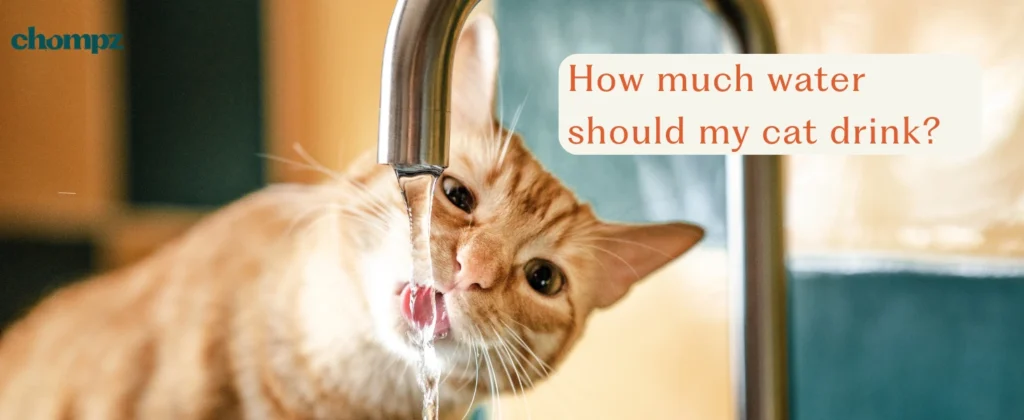
We all know how dramatic cats can be around water. Most of us have seen a bowl full of fresh water at home and our cat ignoring it completely. Plus, if your cat eats mostly dry food, this problem gets even worse.
So let’s talk about how much water your cat really needs every day, and some easy (and affordable) ways to help them stay hydrated.
Why does enough water matter?
Just like us humans, cats can face serious problems if they don’t get enough water.
Problems like:
- Urinary infections (UTIs)
- Bladder or kidney stones
- Chronic kidney disease (CKD, Renal issues)
But good news, unlike us, they don’t need 2–3 liters of water everyday. Instead, the rule of thumb is about 50–60 ml of water per kg of body weight. This is irrespective of your cat’s breed.
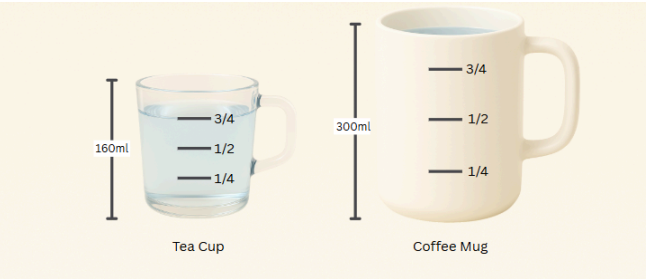
That means if your cat weighs 4 kg, they need around 240 ml of water a day which is roughly the size of a coffee mug (references for the same below the table).
| Cat’s weight (in Kg) | Amount of water daily | How much cups? |
| < 1 Kg | 30 – 40ml | 1/4th of a tea cup |
| 1 Kg | 50 – 60ml | 1/3rd of a tea cup |
| 2 Kg | 100 – 120ml | 3/4th of a tea cup |
| 3 Kg | 150 – 180ml | 1 tea cup |
| 4 Kg | 200 – 240ml | 3/4th of a coffee mug |
| 5 Kg | 250 – 300ml | 1 coffee mug |
| 6 Kg | 300 – 360ml | 1+1/4th of a coffee mug |
| 7 Kg | 400 – 480ml | 1+3/4th coffee mug |
How to Tell if They’re Dehydrated?
You might have seen the skin pinch test in videos (pull up the skin, see if it snaps back quickly). While that’s a quick check, it’s not enough. Hydration is an everyday thing, and a small shortfall adds up over time.
The Real Challenge: Getting Cats to Drink
Cats are desert animals by nature. They don’t always feel thirsty, so we have to make water more appealing. While a lot of people will suggest shifting away from still water in bowls to the small water fountains, studies show that the water bowl type doesn’t really have a big effect on making cats drink water. So before we jump to purchase, below are some easy & cost effective ways to hydrate your cat:
Easy Food Linked Hydration Ways
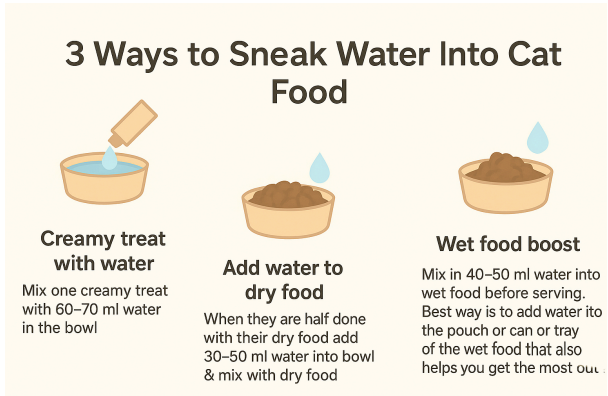
- Creamy treat with water: Mix one creamy treat with 60–70 ml water in the bowl
- Add water to dry food: When they are half done with their dry food add 30–50 ml water into their bowl & mix with dry food.
- Wet food boost: Mix in 40–50 ml water into wet food before serving. Best way is to add water into the pouch or can or tray of the wet food that also helps you get the most out of it
Pro tip: lukewarm water: Many cats prefer water at body temperature over cold water.
Purchases That Might Help
- Fountains: Some cats love running water. In our home, one cat adapted in 2 weeks, another in a month, and one never did.. These generally cost between ₹800–1300 and last over years (our’s are working perfectly well since 3 years). They are also easy to purchase from most online sites, so it is worth trying if you have seen your cat occasionally drinking from their bowl. Leaving links of the 2 types of water fountains we have:
- Fountain1 link
- Fountain2 link
- Bone broths: Cats love them, but packs are pricey (₹95 per 100 ml), need refrigeration & need to be consumed within 3 days of opening. Best as an occasional treat. So unless you make sure to consume it within 3 days, it will lead to wastage & also adds up to unnecessary costs with approx ₹95 per 100ml. But this can be a great occasional thing to supplement & hydrate
- Wet food: Yes, it adds water (around 50–60 ml per pouch), but even 3 pouches a day for an average 4 kg cat only cover ~170 ml out of 240 ml needed. It is a great supplement, but not the entire solution. Additionally, it becomes very expensive to shift to only wet food.
- Extra bowls around the house: Works for some cats, not for others but it’s easy to try with bowls that are not being used already at your home.
Our Takeaway
Start simple by adding water to the food your cat already loves. Once that becomes a habit, experiment with fountains or occasional broths. The goal isn’t just to make them drink more water — it’s to keep their kidneys, bladder, and overall health happy for years.